
What are pool cover and liner welding machines?
Pool cover and liner welding machines are industrial equipment that use heat, pressure, and speed to fuse thermoplastic fabrics — including PVC, polyethylene, and vinyl mesh — into waterproof, structurally sound seams for residential and commercial pool products.
The machines used to produce pool covers are not the same as those used to produce pool liners. Each product type has different structural requirements, material profiles, and manufacturing workflows, which is why dedicated pool cover and liner seam plastic welding machines are configured around specific materials and production goals. Understanding that distinction is the starting point for selecting the right equipment.
Whether you manufacture solar pool covers, safety covers, or vinyl pool liners, the welding machine you choose directly determines your seam quality, production speed, and per-unit cost. Miller Weldmaster designs and builds welding machines specifically for pool cover and liner manufacturers — from standard single-operator units to fully automated systems that weld, cut, and slit in a single pass. This guide covers everything you need to know to select the right machine for your operation.
Principais conclusões
- Pool covers and liners are welded with hot air, hot wedge or radio frequency (RF) welding; the right method depends on your material and seam. Polyethylene (PE) and polypropylene (PP) covers are welded with hot air. PVC and vinyl liners are welded with RF, hot air or hot wedge.
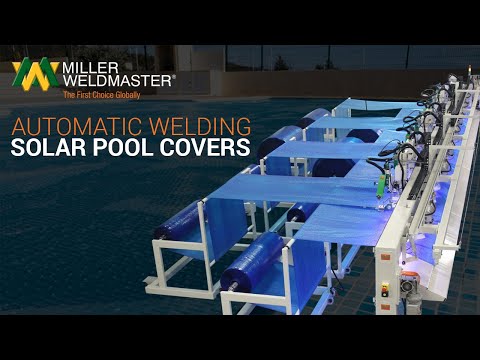
- Automated pool cover welding systems weld multiple rolls at a time, cut and slit covers at the push of a button, and reduce material handling.
- Miller Weldmaster machines support all major pool cover and liner materials: PVC, HDPE, LDPE, PP, and vinyl mesh.
- Standard machines are suited to lower-volume or custom jobs. Automated systems are built for continuous, high-volume manufacturing.
Choose Miller Weldmaster for Your Pool Cover & Liner Welding Machine Needs
Miller Weldmaster schedules on-site installation and operator training with your team, with technicians on site 1 to 3 days depending on the machine. Plus, we provide free weld samples using your own materials before you purchase, allowing you to evaluate seam strength, appearance, and quality with confidence before making your investment.
Pool Covers vs. Pool Liners: What Each Requires
| Coberturas para piscinas | Pool Liners | |
|---|---|---|
| Função principal | Surface protection, heat retention, safety | Structural waterproofing membrane |
| Common Materials | PE, PP, PVC, vinyl mesh | PVC/vinyl, HDPE, LDPE |
| Key Weld Types | Flat panel seams, cut-to-length | Flat seams, sidewall beading welds |
| Production Priority | Speed, multi-roll capability, weld-cut-slit | Seam strength, precision, material compatibility |
| Preferred Weld Method | Hot air (PE/PP); RF (PVC covers) | RF, hot air or hot wedge (PVC/vinyl); hot air or hot wedge (PE) |
Why Welding Beats Sewing or Gluing for Pool Products
Pool products are exposed to UV radiation, pool chemicals, and constant mechanical stress. Stitched seams create needle holes that admit water and become entry points for chemical degradation. Adhesive bonds are vulnerable to heat, moisture, and delamination over time — conditions that are unavoidable in a pool environment.
A properly heat-welded seam has no holes, no adhesive, and no separate fastener. The two layers of thermoplastic material are fused directly — the weld zone becomes a continuation of the fabric itself.
Welding Technologies for Pool Covers and Liners
Hot Air Welding for Pool Covers
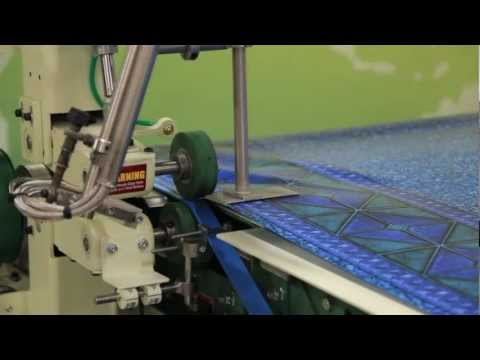
Hot air welding is the most widely used method for manufacturing polyethylene and polypropylene pool covers. A welding machine directs a precisely controlled stream of heated air between two overlapping layers of thermoplastic fabric. As the material surfaces soften, a pressure roller immediately fuses them together — producing a continuous, airtight seam as the machine travels along the panel.
Hot air welding is well-suited to automated production because the process can run continuously at high speed. Automated hot air systems can feed material from multiple rolls simultaneously, weld the seams, and cut the finished cover to length in a single pass. This makes hot air welding the preferred technology for high-volume solar cover, safety cover, and mesh cover manufacturers.
Hot air also welds PVC and vinyl, so for a PVC pool liner the choice depends on the seam: RF is common for liner panel seams, and hot wedge welds the bead and border on Miller Weldmaster's 116 Pool Beading machine.
RF (Radio Frequency) Welding for Pool Liners
RF welding — also called radio frequency welding, dielectric welding, or high-frequency (HF) welding — is widely used for PVC and vinyl pool liners. An RF welding machine passes electromagnetic energy through the PVC material between two electrodes. Because PVC is a polar material, the electromagnetic field causes its molecules to oscillate rapidly, generating heat from within the material itself rather than from an external heat source.
This internal heating mechanism produces a seam that is bonded through the full depth of the material, not just at the surface. For pool liners — which must hold water under continuous hydrostatic pressure and withstand years of chemical exposure — this depth of bond is critical.
Miller Weldmaster offers both standard RF welding machines and custom-engineered RF systems for manufacturers with specific production requirements, such as non-standard table sizes, multi-electrode configurations, or integration into an existing production line.
Impulse and Ultrasonic Welding: Niche Pool Applications
Impulse welding applies a brief, controlled pulse of electrical current to a sealing bar, generating heat at the material interface and immediately cooling under pressure. It requires no warm-up time, which makes it useful for repair work, short production runs, and applications where precise, localized seams are needed. Miller Weldmaster lists its Impulse Extreme for pool work.
Ultrasonic welding uses high-frequency mechanical vibration to generate heat at the bond interface. It is an option for specific applications rather than a main method for pool cover or liner production.
Pool Cover and Liner Materials and How Each Is Welded
The material you process sets your welding method, machine setup and weld settings (temperature, speed and pressure). Below are the main pool cover and liner materials and how each is welded. For a fuller look at what pool covers are made of, see our guide to the materials used to manufacture pool covers.
Pool Cover Materials
Pool covers are produced in several material types, each with different UV resistance, weight, and performance characteristics:
- UV-stabilized polyethylene (PE / HDPE / LDPE): The dominant material for solar pool covers and most solid safety covers. Lightweight, UV-stabilized, and available in bubble, flat, and foam-laminated formats. Welded with hot air.
- Polypropylene (PP): Used for mesh safety covers that allow rainwater to pass through while blocking debris. Woven construction; welded with hot air at parameters appropriate for PP.
- PVC-coated fabric: Used for premium solid covers and some commercial pool covers. Heavier than PE; may be welded with RF depending on construction, or hot air where the PVC coating weight supports it.
Pool Liner Materials
Pool liner material selection is driven by pool type, water chemistry exposure, and the required service life of the liner:
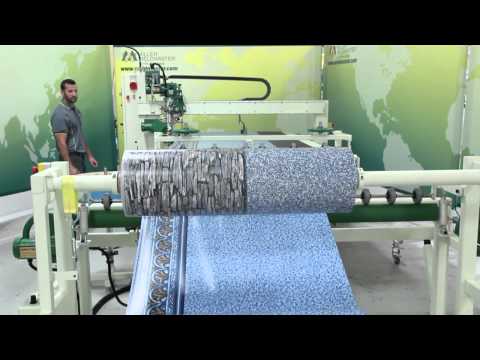
- PVC / vinyl: The dominant material for above-ground and in-ground residential pool liners. Flexible, printable with decorative patterns, and chemically resistant to pool treatments. Welded with RF, hot air or hot wedge.
- HDPE (high-density polyethylene): Used in commercial pools, water parks, and specialty installations requiring greater chemical resistance or structural rigidity. Welded with hot air or hot wedge.
- LDPE (low-density polyethylene): Used in some residential liner applications and specialty installations. More flexible than HDPE; welded with hot air.
Material thickness and weight affect welding speed, temperature settings, and the pressure profile required. Thicker liner materials run at lower speeds and higher temperatures than thinner covers. Miller Weldmaster can perform a free weld sample on your specific material to confirm parameters before you configure or purchase a machine.
Choosing the Right Pool Cover or Liner Welding Machine
Selecting the right welding machine comes down to five decisions. Work through them in order — each one narrows the options and leads you to the right configuration for your production line.
Step 1 - Identify Your Material
Start here. Your material determines your welding method, which significantly narrows your machine options. Polyethylene (PE) and polypropylene (PP) covers are welded with hot air. PVC or vinyl pool liners can be welded with RF, hot air or hot wedge, depending on the seam. If your line runs both material types, a hot air machine can weld both, or you can add an RF machine for liner panels. If unsure, request a free weld sample from Miller Weldmaster to get expert advice before purchasing.
Step 2 - Determine Your Production Volume
Volume determines whether you need a standard or automated welding machine. Low to mid-volume production, such as custom orders or smaller runs, typically uses manual or semi-automatic machines operated by one person, offering lower upfront costs but higher labor per piece. High-volume production benefits from automated systems that reduce labor, handle material movement mechanically, and maintain consistent weld quality over long runs. The exact threshold depends on product complexity and labor costs, and Miller Weldmaster's sales team can help identify the best fit for your operation.
Step 3 - Decide on Capabilities: Weld-Only vs. Weld-Cut-Slit
Some manufacturers require machines that only weld seams, while others benefit from combining welding, cutting, and slitting into a single automated pass. Miller Weldmaster's automated systems can handle multiple operations at once, feeding material from multiple rolls, welding seams, cutting panels to length, and slitting edge trims. This integration streamlines production, reducing handling time and ensuring dimensional consistency. The result is a finished pool cover produced efficiently from raw roll material in one continuous operation.
Step 4 - Consider Pool Type and Product Size
Above-ground residential pools, in-ground custom pools, and commercial pools require covers and liners of various sizes and shapes. Your welding machine must accommodate the largest panel size in your product range. For pool liners, the bead weld can run on its own machine: Miller Weldmaster's 116 Pool Beading machine welds the bead to the liner border with hot wedge welding, and its optional sidewall system welds border to wall and bead to border at the same time.
Step 5 - Evaluate Training, Support, and Long-Term Service
The machine is only part of the equation. Miller Weldmaster schedules on-site installation and training, with technicians present for 1 to 3 days depending on the machine. They train your operators on setup, weld parameters, maintenance, and quality checks, so you’re not left to figure it out alone. Ongoing service, spare parts, and technical support are also provided to ensure long service life and minimize downtime. This support is especially important for automated systems where production continuity is critical.
Recommended Machine Type for Pool Cover and Liner Manufacturing
| Cenário de produção | Recommended Machine Type | Método de soldadura | Key Capability |
|---|---|---|---|
| Custom or small-run pool covers | Standard manual hot air machine | Ar quente | Single-seam welding; operator-guided; lower volume |
| High-volume solar and safety covers | Automated hot air system (e.g., M100) | Ar quente | Welds multiple rolls and cuts each cover to length |
| PVC / vinyl pool liner production | Standard or custom RF welding machine | RF / dielectric | Water-tight PVC and vinyl seams |
| Liner sidewall beading welds | 116 Pool Beading machine | Cunha quente | Welds the bead to the liner border; optional sidewall system |
| Dual-material production (PE covers + PVC liners) | Two separate machines or custom multi-tech system | Hot air + RF | Each material welded with the correct technology |
Standard vs. Automated Pool Cover and Liner Welding Machines
The decision between a standard machine and an automated system is the highest-impact capital decision a pool cover or liner manufacturer makes. Both categories produce production-quality welds. The difference is in throughput, labor requirements, and operational flexibility, and many manufacturers ultimately move toward automated production of pool covers and liners to keep pace with demand and quality expectations.
Standard (Manual) Welding Machines
Standard machines are manually operated. One operator guides the material through the machine, monitors weld quality, and advances the panel. These machines are appropriate for:
- Custom pool cover or liner orders where each product has unique dimensions.
- Lower-volume production runs that do not justify the capital investment in automation.
- Operations that are growing and building toward automation — standard machines serve well as a starting point.
- Specialty seam types or product configurations that require operator judgment and adjustment.
Standard machines from Miller Weldmaster still deliver precise, repeatable weld parameters — they are not hand tools or portable welders. They include temperature and speed control, consistent pressure application, and the same material compatibility as automated systems in the same technology category.
Sistemas de soldadura automatizados
Automated welding systems are built for continuous, high-volume production, maximizing throughput per labor hour by handling material automatically and maintaining consistent weld quality.
Key capabilities of Miller Weldmaster's automated pool systems include:
- Welding multiple roll widths simultaneously, joining panels from various rolls in one production pass.
- Automatic cutting to finished length, removing the need for separate cutting steps.
- Slitting edge material for a clean finished edge.
- Digital display of weld parameters such as temperature and speed.
- Reduced material handling.
The M100 is Miller Weldmaster's automated pool system, designed to weld multiple panels and cut to length simultaneously. It suits high-volume manufacturers of solar, safety, and flat-panel pool covers aiming to increase throughput and reduce per-unit costs.
Choosing between standard and automated systems depends on your production volume and labor model. For example, producing 50 custom covers weekly differs greatly from producing 500 standard solar covers daily. Miller Weldmaster's team can help determine the right investment based on your current and projected needs.
Bringing Pool Cover and Liner Production In-House: The Business Case
Many pool cover and liner manufacturers currently outsource some or all of their seam welding. The decision to bring that work in-house — by purchasing a welding machine — is a capital investment decision. Three outcomes drive the business case: cost reduction, quality control, and production flexibility.
Reducing Per-Unit Cost vs. Outsourced Seam Work
Outsourcing seam welding adds a per-unit cost that is paid on every product you ship. That cost includes the contractor's margin, transportation, lead time, and the coordination overhead of managing an external production step. Owning the machine converts that recurring variable cost into a fixed capital investment with a defined payback period.
For manufacturers at sufficient volume, the per-unit cost savings from in-house production accumulate quickly. The machine cost amortizes over its service life while the per-unit savings compound with every product welded. Manufacturers who bring production in-house with Miller Weldmaster equipment are also better positioned to absorb volume increases without proportional cost increases — adding volume to an owned machine is low-marginal-cost; adding volume to an outsourced operation is full variable-cost.
Quality Control You Own
When seam welding is outsourced, you do not control the temperature settings, the pressure parameters, or the quality checks on each seam. You receive a finished product and trust that the contractor's process was consistent. If a seam fails in the field — on a pool liner under hydrostatic pressure, or a safety cover under load — the liability is yours.
Owning the welding machine means owning the process. You set the weld parameters for your material, your thickness, and your quality standard. Automated systems display weld parameters such as temperature and speed, so the operator sees changes as they happen. If a batch has a problem, you identify it at the machine, not after delivery.
Pool installers and distributors depend on consistent, defect-free seams. Bringing welding in-house puts that consistency under your control instead of a supplier's.
Throughput Flexibility for Seasonal Demand
Pool cover demand is seasonal. The window between late winter and early summer concentrates a large portion of the annual production requirement. Manufacturers who depend on outsourced welding face lead time constraints during exactly the period when speed matters most — an outsourced operation that is backed up in March cannot prioritize your orders over their other customers.
In-house welding capacity means you control the production schedule. When demand spikes, you run the machine longer. Automated systems can weld multiple rolls simultaneously, multiplying throughput per labor hour during peak season without proportional increases in labor cost. When the season ends, the capital investment does not go away — but neither does the operational advantage for next year.
Miller Weldmaster Pool Cover and Liner Welding Machines
Miller Weldmaster designs, manufactures, and supports welding machines used by pool cover and liner manufacturers worldwide. The product range spans standard single-operator machines for custom and lower-volume production to fully automated systems built for continuous high-volume manufacturing — with engineered custom solutions available for operations that need something the standard range does not cover, built on hot air, hot wedge, RF and impulse welding.
The M100 — Automated Pool Cover Welding and Cutting System
The M100 is Miller Weldmaster's purpose-built automated system for pool cover manufacturing. It is designed to weld multiple panels together and cut the finished cover to length simultaneously — combining what would otherwise be two separate production operations into one continuous pass.
The M100 is suited to manufacturers producing solar covers, safety covers, and other flat-panel pool cover products at high volume. Key production advantages include:
- Weld multiple panels in a single automated pass.
- Cut to finished length automatically — no secondary cutting step.
- Fabric and keder unwinds with tension controls for less material handling.
- PLC touch screen with recipe storage for quick changeovers.
The 116 Pool Beading Machine
The 116 Pool Beading machine is built for one step in pool liner production: welding the bead to the liner's sidewall.
The bead is the strip that holds the liner in the track along the top of the pool wall, so the weld must be strong and consistently placed along the full length of the panel. The 116 uses hot wedge welding, a powered beading dispenser and a driven unwind for the pool vinyl, and its optional sidewall system welds border to wall and bead to border at the same time.
Standard Machines for Lower-Volume or Custom Pool Production
For manufacturers who need production-quality welding at lower volume, or who produce custom pool covers and liners with variable dimensions, Miller Weldmaster's standard machine line provides a lower-investment entry point with the same technology fundamentals as the automated systems.
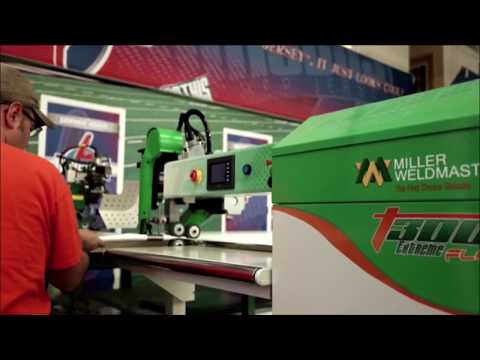
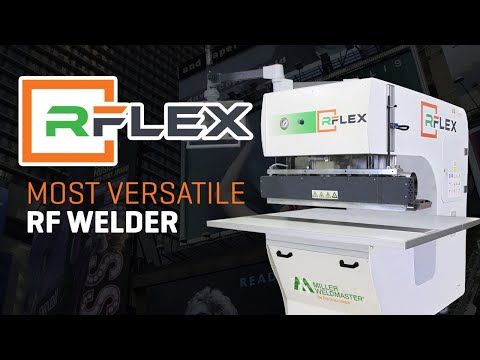
Miller Weldmaster's standard machines for pool work include the T300 Flex and T600 Flex hot air and hot wedge welders, the 112 Extreme for long, straight seams, the portable Triad Extreme Universal hot wedge welder, and the RFlex and RFlex Travel radio frequency welders for PVC and PU. Hot air machines weld PE, PP and PVC cover and liner materials; RF machines weld PVC and vinyl. Both include temperature and speed control, consistent pressure and Miller Weldmaster's on-site installation and training. Every machine for pool work is in the pool machine finder.
Custom and Engineered Pool Welding Solutions
Some pool cover and liner manufacturers have production requirements that fall outside the standard range: non-standard pool shapes, unusually wide panels, multi-material production lines, integration with existing manufacturing cells, or specific throughput targets that require a purpose-built system.
Miller Weldmaster designs and builds custom automated welding systems for these requirements. Custom RF systems are available for manufacturers who need non-standard electrode configurations or table geometries and want to take advantage of custom radio frequency (RF) machine technology. Custom hot air systems are available for multi-roll, high-width, or high-speed applications. The starting point is a conversation with a Miller Weldmaster applications specialist — not a catalog selection.
See which Miller Weldmaster machine fits your pool cover or liner production line. Request a free weld sample on your material, or connect with a welding specialist to discuss your production requirements.